
Family Statistics Ireland 2026: 30.8% of Private Households Include Children
Sources reviewed: 14 October 2026 | Estimated read time: 12 minutes | Human written and fact checked against each named source.
Families shape how homes are occupied, furnished and adapted over time, but Irish statistics use several different definitions of a family, household and child. This 2026 roundup brings those measures together without treating them as interchangeable. Its detailed family baseline comes from Census 2022, while newer supporting indicators cover 2024 and 2025 and the childhood housing study follows children from 2008–09 to 2017–18.
Family statistics Ireland: key figures at a glance
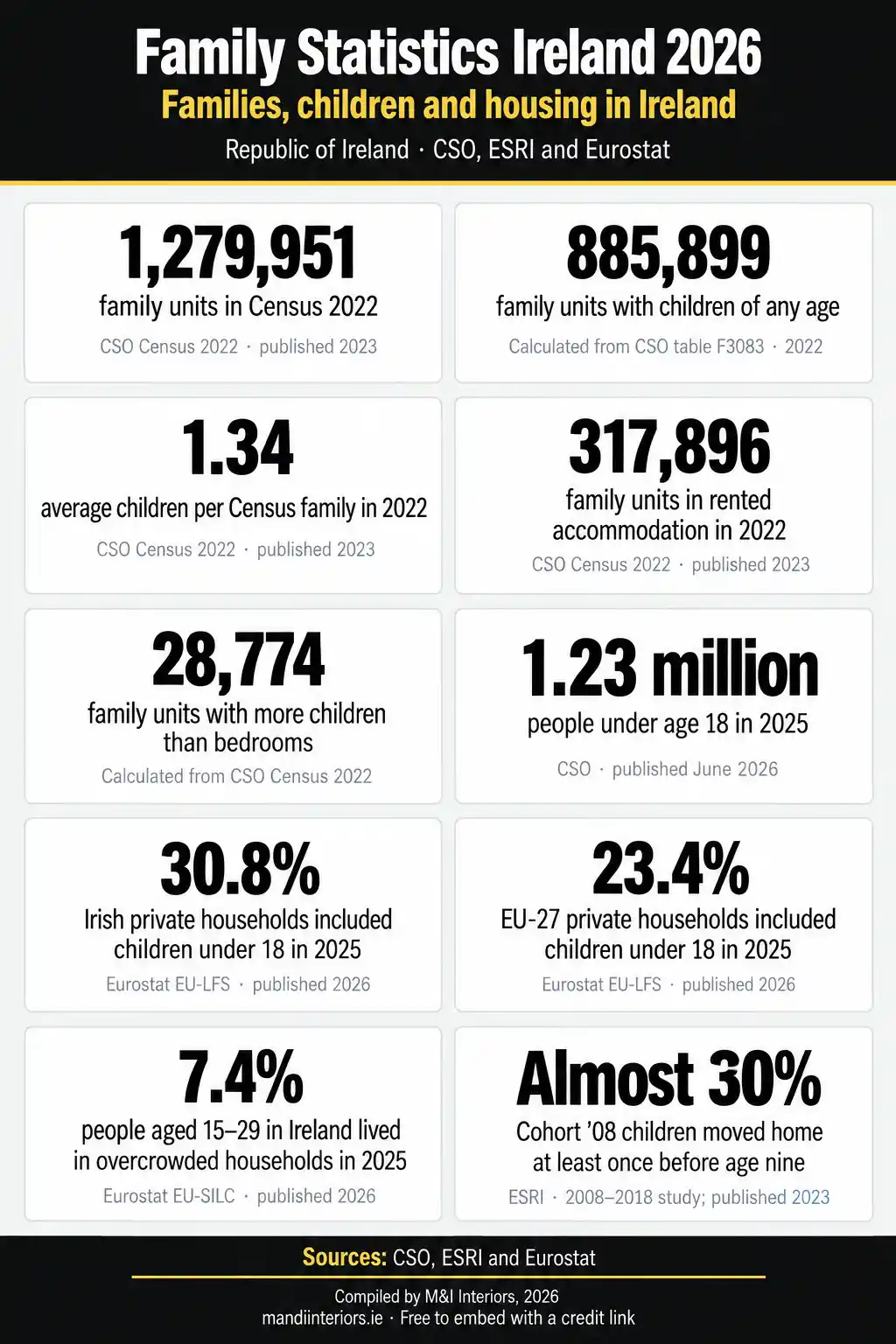
- Ireland had 1,279,951 family units on Census Night in 2022, an increase of 5% since 2016, according to the CSO family release.
- Adding the four Census family types with children gives 885,899 family units, equal to 69.2% of all family units in 2022, based on the CSO family table.
- The average number of children per Census family was 1.34 in 2022, down from 1.82 in 1996, the CSO trend data show.
- A total of 317,896 family units rented from a private landlord, local authority or voluntary or co-operative body in 2022, according to the CSO accommodation figures.
- The Census bedroom figures indicate that 28,774 family units had more children than bedrooms, a calculated 2.2% of all family units; the CSO bedroom section rounds this to nearly 29,000 and 2%.
- Ireland had approximately 1.23 million people under age 18 in 2025, according to the CSO children update.
- In 2025, 30.8% of Irish private households included children under 18, based on the Eurostat household data.
- The equivalent EU-27 share was 23.4% of private households in 2025, using the same Eurostat household measure.
- In 2025, 7.4% of people aged 15–29 in Ireland lived in households classed as overcrowded under the Eurostat room standard, the Eurostat comparison reports.
- In the ESRI’s Cohort ’08 study, almost 30% of children moved home at least once between infancy and age nine, according to the ESRI housing study.
Free to embed. Please credit M&I Interiors with a link to this page: https://mandiinteriors.ie/family-statistics-ireland/
How many families are there in Ireland?
The 2022 Census definition treats a family unit as a married or cohabiting couple, with or without children, or one parent with at least one child. Family members must usually live in the relevant household.
On that basis, the Census counted 1,279,951 family units in the State on 3 April 2022. That was 5% more than in 2016. Looking further back, the family-unit count rose by 59% between 1996 and 2022, from 806,835 to 1,279,951, according to the CSO family series.
A family unit is not the same as a private household or dwelling. A private household can contain one person or several people with common housekeeping arrangements, and a household can include more than one family unit. That distinction matters when comparing Census family figures with household statistics from other sources.
The Census definition of a child also needs care. Within a family unit, a child is a usually resident, never-married son or daughter of any age. The 885,899 family units calculated as having children therefore cannot be described as 885,899 families with children under 18.
What types of family units were recorded?
Married couples with children formed the largest of the six family types in the CSO family table. The Census recorded 580,641 married-couple family units with children and 85,262 cohabiting-couple units with children in 2022.
Among couples without usually resident children, there were 302,358 married-couple units and 91,694 cohabiting-couple units. “Without children” describes the household composition on Census Night. It does not show whether the couple had adult children living elsewhere.
One-parent families numbered 219,996 when the two CSO categories are combined. This total comprised 186,487 one-parent-mother units and 33,509 one-parent-father units. The father-family count increased by 13%, or 3,804 units, between 2016 and 2022, while the mother-family count decreased by 1%, the Census family findings show.
Calculated against the 885,899 family units with children, one-parent units represented 24.8% of that group. This is a share of family units, not a percentage of Irish children living in one-parent families. A child-level measure would require a different denominator.
The Census also recorded 10,393 same-sex couples in 2022, 72% more than in 2016. There were 1,853 children in same-sex-couple family units, an increase of 86% over the same period, according to the CSO couple figures. These child counts use the same any-age Census definition.
Children, family size and stages of family life
The number of family units and the average number of children moved in different directions over the longer term. Family units increased by 59% between 1996 and 2022, while the average number of children per family fell from 1.82 to 1.34, according to the CSO historical series.
The average also varied geographically in 2022. Dublin City had an average of 1.11 children per family, while Monaghan averaged 1.49, based on the CSO county data. These figures describe the average across Census family units and do not measure household fertility or the number of children under 18.
Family-cycle categories provide another view of how households change. Units where the eldest child was aged 20 or over were the largest category, representing 27% of family units in 2022. Pre-school and early-school units, where the eldest child was aged 0–4 or 5–9, together represented 18% and were 14% lower in number than in 2016. Retired couple-family units made up 12% of families and increased by 26% over the six years, the CSO family-cycle figures show.
Newer population estimates offer a different, age-specific perspective. Ireland had approximately 1.23 million people under 18 and just over 467,000 people aged 18–24 in 2025, according to the CSO hub update. These are person-level population estimates, so they should not be added to or substituted for family-unit counts.
The same CSO update reported that births to mothers younger than 20 declined from 1,380 in 2013 to 683 in 2023. The comparison describes births in those two years. It is not a 2026 birth figure and does not explain why the change occurred.
How many Irish families rent their homes?
The Census counted 317,896 family units in rental accommodation in 2022. This total combined homes rented from private landlords, local authorities and voluntary or co-operative bodies, and it was 10,102 units, or 3%, higher than in 2016, according to the CSO tenure section.
The total should not be described as 317,896 private-renting families because it includes three different rental categories. It also counts family units rather than every person, tenancy registration or rental property.
Housing tenure during childhood is examined separately in an ESRI longitudinal study. Among children in the Growing Up in Ireland Cohort ’08, 75% lived in owner-occupied housing at age nine, 12% lived in social housing and 11% lived in private rented accommodation. Just over 1% lived with their parent or parents in their grandparents’ home.
Those ESRI percentages describe a nationally representative study cohort at age nine in 2017–18. They are not current administrative totals, and they should not be used to estimate the number of children in each tenure in 2026.
Bedrooms and space in family homes
Bedroom counts reveal something about the relationship between family size and available rooms, but they do not show sleeping arrangements directly. Adding the four categories displayed by the CSO gives 28,774 family units with more children than bedrooms in 2022. That equals 2.2% of the 1,279,951 family units, while the CSO bedroom summary rounds the result to nearly 29,000 and 2%.
The calculation does not prove that every child in those homes shared a bedroom. It does not identify how bedrooms were allocated, whether parents used a bedroom, or whether another room was used for sleeping. It also says nothing about room size, storage or the condition of the dwelling.
The relationship was more pronounced among larger families. Of families with five or more children, 7,931 had four or fewer bedrooms, representing 60% of that group, according to the CSO bedroom figures.
This Census comparison is different from Eurostat’s overcrowding rate. The Census compares children and bedrooms within family units. Eurostat applies a minimum number of rooms based on the number of people, couples and the ages and sex composition of household members. The two measures should be explained separately rather than combined into one space-pressure statistic.
What do we know about children’s housing experience?
The ESRI followed the Growing Up in Ireland Cohort ’08 from infancy to age nine. At age nine in 2017–18, approximately one in ten children lived in accommodation their parent considered unsuitable, mainly because of its size, according to the ESRI research report. This was a parent-reported assessment rather than a physical inspection.
Approximately one in ten children had also lived in a home their parents could not afford to keep adequately warm at one or more observed stages. For 7% of children, the inability to afford adequate warmth was a persistent problem across the childhood waves examined by the ESRI housing analysis.
Residential mobility was common but should not automatically be interpreted as instability. Almost 30% of children moved home at least once between nine months and age nine, and 7% moved at least twice, the same ESRI study found. The authors noted that moves occurred across income groups and could reflect different family circumstances.
The study identified associations between housing conditions and child outcomes, but it does not prove that one housing characteristic caused a particular health, educational or socio-emotional result. It also notes that families experiencing homelessness were extremely unlikely to be represented in the study sample.
More recent CSO indicators add a narrower view of household resources. In 2024, fewer than 1% of households with children under 16 were unable to afford age-appropriate books. A further 5.9% were unable to afford regular leisure activities, such as swimming or playing an instrument, according to the CSO children indicators. These percentages measure affordability, not whether a family wanted or used a particular book or activity.
Ireland compared with the EU
Eurostat provides a directly comparable household measure for Ireland and the EU-27. In 2025, 30.8% of private households in Ireland included at least one child under 18, compared with 23.4% of private households across the EU-27, according to the Eurostat household release. Both figures come from the EU Labour Force Survey and use the same under-18 definition.
Among Irish households with children, 56.7% had at least two children in 2025. The share with three or more children was 19.2%, the Eurostat composition data show. Both percentages use households with children as the denominator, not all Irish households.
A second comparable series looks at people aged 15–29 living in overcrowded households. Ireland’s rate was 7.4% in 2025, compared with 26.9% across the EU-27, according to the Eurostat overcrowding release.
The lower Irish rate under this harmonised measure does not mean that every Irish family has adequate space. Eurostat’s overcrowding standard is a national sample-based measure of rooms and household composition. It differs from a bedroom count, a floor-area measure and a personal assessment of whether a home is suitable.
Methodology and definitions
This roundup was compiled from primary material published by the Central Statistics Office, Eurostat and the Economic and Social Research Institute. The sources were reviewed on 14 October 2026. The year 2026 in the title is the publication year of this roundup, not the measurement year of every statistic.
The detailed family structure, family cycle, accommodation and bedroom figures come from Census 2022 and primarily describe usual residents on 3 April 2022. Census family-unit children are never-married children of any age. The calculated total of 885,899 family units with children adds the four compatible CSO family types, and 69.2% is that total divided by 1,279,951 family units.
The calculated bedroom figure adds four CSO chart values: 2,167, 6,161, 12,515 and 7,931, producing 28,774 family units. Dividing that total by 1,279,951 gives 2.2%, while the CSO narrative rounds the result to 2%. It must not be presented as a direct count of children sharing rooms.
The 2024 and 2025 child indicators come from the CSO’s Children and Young Persons Hub update. Approximate values such as 1.23 million are kept approximate. No 2026 population count has been manufactured from an earlier percentage.
The ESRI figures are survey estimates for the Growing Up in Ireland Cohort ’08. The cohort was observed from 2008–09 to 2017–18, and its age-nine housing measures are not current 2026 prevalence estimates. The public executive summary does not supply confidence intervals for the descriptive percentages used here.
Eurostat’s 2025 household-composition figures come from the EU Labour Force Survey, where a child is younger than 18. The 2025 overcrowding figures come from EU-SILC and cover people aged 15–29. Both are sample estimates rather than administrative counts, and the public releases do not provide confidence intervals for the quoted country percentages.
The CSO’s later administrative family and household estimates were reviewed but not used as replacements for the Census baseline. The CSO labels them as a Frontier Series output, says they are not the official family statistics and warns that they are not directly comparable with the Census.
Creating practical rooms for family life
These statistics describe how Irish families are composed and housed. They do not prescribe how any individual family should arrange a room, and furniture cannot resolve inadequate housing or overcrowding.
Where a family is already planning or furnishing a child’s room, practical choices can include matching the bed and storage to the available floor space, preserving clear circulation and selecting pieces that can adapt as routines change. M&I Interiors’ children’s furniture collection includes beds, coordinated room sets, study furniture and storage for families comparing those options.
Related Irish housing statistics
For wider context, M&I Interiors’ home size statistics cover bedrooms, floor area and rooms per person across the housing stock. The apartment living figures examine apartment residents, tenure, bedroom counts and construction, while the moving home statistics cover movers, destination tenure and dwelling type.