

Moving Home Statistics Ireland 2026: 61% of Moving Households Rented Their Next Home
Sources reviewed 29 September 2026 | Approximately 12-minute read | Human written and fact checked against each named source.
Moving home changes more than an address. It can mean entering a different tenure, adapting to another type of property and furnishing rooms with new proportions and practical demands. Ireland’s official figures show that these experiences vary considerably by age, county and whether a household rents, owns with a mortgage or owns outright.
This is a 2026 statistical roundup, but its central evidence comes from Census 2022 migration data and measures moves made in the year before the census. The most recent supporting market figures cover July and August 2026, while the survey evidence measures 2023 views. Each statistic below states its own population and period so that people, households, property purchases, mortgage events and stated intentions are not treated as interchangeable.
For related information about the homes people are moving into, see our Irish new homes statistics and apartment living statistics.
Moving home statistics Ireland 2026: key figures at a glance
- In the year before Census 2022, 265,098 people moved within the State, equal to 5.3% of usual residents aged one or over.
- Some 76,683 people changed county, representing 29% of people who moved within the State.
- Age 26 was the peak moving age, with 15% of residents moving at that age in the year before Census 2022.
- The Census recorded 112,548 moving households in the year before Census 2022.
- Of those households, 68,284 entered rented accommodation, equal to 60.7% of the total.
- A further 26,443 entered mortgaged homes, equal to 23.5% of moving households.
- Flats and apartments were the most common destination type, receiving 34% of moving households.
- Among moving renter households, 49% chose an apartment or flat.
- Former owner-occupiers made 25,670 dwelling purchases in the 12 months to July 2026, exactly 50.0% of household market purchases filed with Revenue.
- Mover purchasers accounted for 982 mortgage approvals in August 2026, equal to 19.3% of approvals reported by participating BPFI institutions that month.
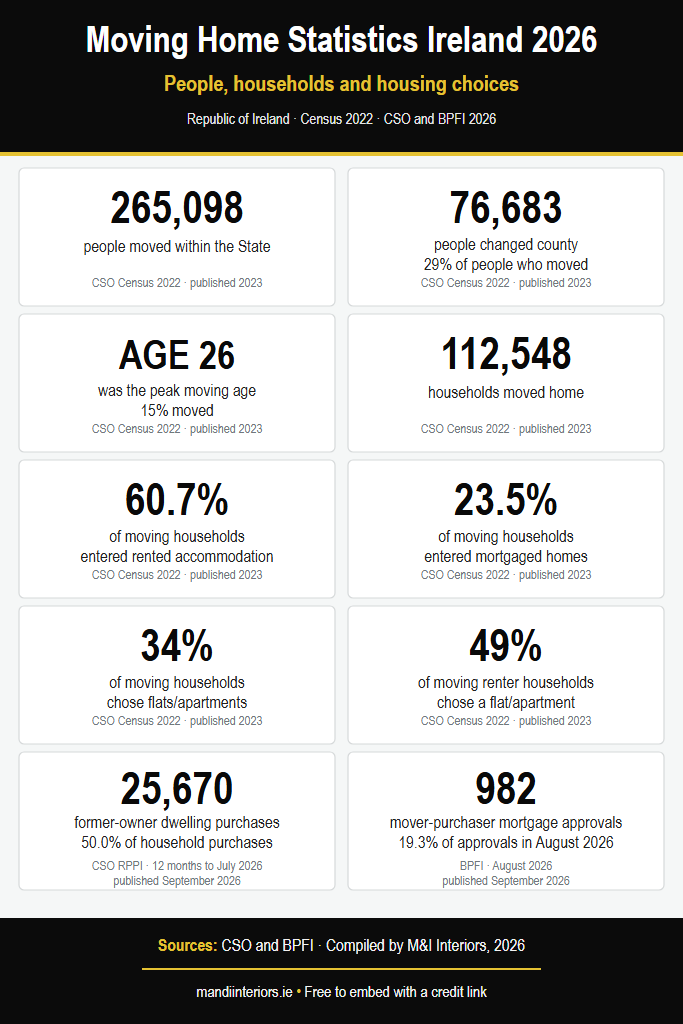
Free to embed. Please credit M&I Interiors with a link to this page: https://mandiinteriors.ie/moving-home-statistics-ireland/
How many people move home in Ireland?
The Central Statistics Office uses a Census question about a person’s usual residence one year earlier to measure movement within Ireland. It applies to usual residents aged one year and over who were present in the State. On that basis, 265,098 people moved within the State in the year before Census 2022.
The increase from 2016 was 1,547 people, or 0.6%. The population also grew between the two censuses, however, so the share of usual residents moving fell from 5.7% in 2016 to 5.3% in 2022. The count and rate therefore tell slightly different stories: there were marginally more movers, but moving was slightly less common across the larger population.
Most movement stayed within county boundaries. Some 188,415 people moved within the same county, equal to 3.7% of usual residents aged one or over. Another 76,683 changed county, representing 1.5% of usual residents and 29% of everyone who moved within the State.
These are person-level counts. They should not be added to the household figures later in this article because several people can belong to one moving household.
At what age are people most likely to move?
Moving was most common in early adulthood. Age 26 was the single-year peak, when 15% of 26-year-olds moved within the State during the year before Census 2022. The likelihood then generally decreased with age.
The average age of an individual mover was 31.7 years. That average should not be confused with the age of a household reference person, which the CSO uses when breaking household moves down by tenure and dwelling type.
The average reference-person age in a moving household was 37.7 years. The age differed by tenure: it was 34.8 among households entering rentals, 38.4 among those entering mortgaged homes and 52.0 among those entering homes owned outright.
The tenure pattern changed sharply between age groups. Among moving households headed by someone under 30, 80.4% entered rented accommodation. For households headed by someone aged 30 to 49, 54.9% entered a rental and 33.4% entered a mortgaged home.
Later-life moves showed a different balance. Among moving households headed by someone aged 50 to 64, 45.6% entered a rental and 30.5% entered a home owned outright. For households headed by someone aged 65 or over, 57.5% entered outright ownership, while 30.9% entered a rental and 5.5% entered a mortgaged home.
Which counties do movers leave and choose?
County boundaries mattered more in some places than others. Among people who had lived in Roscommon and moved, 46% changed county, the highest share in the State. Among movers previously resident in Cork, only 18% left their county.
Dublin had the largest volume. The CSO counted 93,473 Dublin-origin movers who moved within or out of the county. Of that group, 21,954 people left County Dublin, equal to 23%.
Neighbouring counties were prominent destinations for Dublin leavers. More than 4,000 moved to Kildare, while 3,285 moved to Meath.
These figures describe origins and destinations, not motives. They cannot show whether a person moved for work, family, cost, space or another reason.
Do moving households rent or buy?
The Census recorded 112,548 private households moving within the State in the year before Census 2022. This household measure is based on responses from the household reference person.
Renting was the largest destination-tenure category. Some 68,284 moving households rented their next accommodation, equal to 60.7% of moving households. A further 26,443 entered mortgaged homes, representing 23.5% of the total. That mortgaged-home count increased by 36% from 2016.
Another 12,278 households entered outright ownership, equal to 10.9% of moving households. This means the destination property was owned without a mortgage or loan. It does not necessarily mean that every property had just been bought for cash.
Tenure also varied by destination county. Meath had the highest proportion of moving households entering a mortgaged home, at 43% of Meath movers. Dublin led for rentals at 69% of moving households, while Roscommon led for outright-owned homes at 24%.
What types of homes do moving households choose?
Flats and apartments were the largest single destination category. They received 34% of moving households, compared with 23% moving into detached houses, 22% into semi-detached houses and 21% into terraced houses.
Tenure helps explain that overall mix. Among households entering rented accommodation, 49% moved into apartments or flats. By contrast, approximately 70% chose houses that were detached or semi-detached when entering a mortgaged home. Among households entering outright ownership, 52% chose detached houses.
Destination type also differed with age. The average household reference person was 33.9 years old for a move into a flat or apartment, 37.4 for a terraced house, 38.6 for a semi-detached house and 42.7 for a detached house.
Among moving households headed by someone under 25, 54.1% entered an apartment or flat. At the other end of the age range, 40.1% entered detached houses among moving households headed by someone aged 65 or over.
The county pattern reflected different housing stocks and markets. Flats and apartments received 55% of Dublin movers. Detached houses received 53% of Roscommon movers. Kildare’s semi-detached share was 39%, while Louth’s terraced share was 28%.
For more detail about apartment residents, tenure and space, see our Irish apartment figures. Our home size statistics provide separate evidence on bedrooms, floor area and rooms per person.
How active is the current home-mover market?
The Census provides the strongest national picture of completed moves, but more recent transaction and mortgage data offer a narrower view of owner-occupier market activity. These measures must remain separate because a purchase, mortgage approval and mortgage drawdown occur at different stages and do not necessarily equal one completed household move.
In the 12 months to July 2026, households filed 51,310 market-price purchases with Revenue. Former owner-occupiers made 25,670 of those purchases, exactly 50.0% of the total. The latest three months in the CSO release were provisional and may be revised.
In August 2026, mover purchasers accounted for 982 mortgage approvals, or 19.3% of the 5,083 approvals reported by participating BPFI institutions. Their approvals were worth €389 million, representing 23.2% of the €1.678 billion approved that month.
Drawdowns measure lending that has progressed beyond approval. Participating institutions recorded 2,017 mover drawdowns in Q2 2026, 1.1% more than a year earlier. Their value reached €788 million, a year-on-year increase of 4.7%.
These lender figures exclude cash purchases and may not cover every lender operating in Ireland. Approval value is not the same as a home’s sale price, and an approval should not be described as a completed transaction.
Do people in Ireland plan to move?
A BPFI housing survey conducted by Amárach Research in July 2023 provides useful, but dated, evidence about housing intentions. The online omnibus survey included 1,200 adults aged 18 or over in the Republic of Ireland, with quotas and weighting used to align the final sample with the national population by gender, age, region and social grade.
In that survey, 59% of adults reported living at their current address for more than ten years. Among owner-occupiers, the corresponding share was 70%.
More than half of adults, 56%, had no plans to move from their current home. Among owner-occupiers, the corresponding share was 72%.
The pattern was different among people who did not own their home. Within that subgroup, 59% planned to move within five years.
Among respondents aged 18 to 34, 66% planned to move within five years. The result is calculated by adding the published response categories for moving within 12 months, one to three years and four to five years. Because the component percentages are rounded, the sum may carry a small rounding effect.
Plans do not always become moves. These findings should be described as July 2023 intentions rather than a forecast of how many people will move.
Methodology and sources
This article was compiled from five primary statistical sources and reviewed on 29 September 2026. The core evidence comes from the CSO internal migration chapter in Census of Population 2022 Profile 1. Current market context comes from the CSO July transaction data, BPFI August approvals and BPFI Q2 drawdowns, all published in 2026. Housing-intention evidence comes from the BPFI 2023 survey conducted by Amárach Research.
The Census person-level figures cover usual residents aged one year and over who were present in the State and changed usual residence within Ireland in the year before Census 2022. They exclude moves into Ireland from abroad. Household-level results use the private household and the age of its household reference person. A household can contain more than one person, so person and household counts are not interchangeable.
The CSO transaction figures are household market dwelling purchases filed with Revenue. BPFI approval and drawdown figures are lending events reported by participating institutions. None of these series should be treated as a direct current count of completed household moves.
The BPFI housing survey represents stated circumstances and intentions among a weighted online sample of adults. Confidence intervals were not published in the report. Survey intentions are not observed outcomes.
The year 2026 in the title is the roundup and review year, not the data period for every statistic. No projection has been presented as an observed result. The only calculated article figure is the 66% five-year intention among respondents aged 18 to 34, formed from the survey’s published 21%, 29% and 16% response categories.
Eurostat’s census grid publishes harmonised 2021 categories for residence one year before the census. No Ireland-versus-EU section is included here because the available primary release does not provide a stable, ready-published EU-27 aggregate directly comparable with the CSO figure, and Ireland’s data were adjusted to a different reference date for the European release. A new EU calculation was not created for this roundup.
How M&I Interiors can help after a move
A move can require an existing collection of furniture to work in rooms with different dimensions, doors, windows, circulation routes and storage. The statistics show why there is no single furnishing formula: a rented apartment, semi-detached family home and detached house can demand very different decisions even when the household itself has not changed.
M&I Interiors can help plan furniture around the measurements and everyday use of an individual room. For a coordinated starting point, our living room sets include arrangements that can be adapted to different layouts and styles. Larger pieces should always be checked against room dimensions, access routes and the clear space needed to move comfortably around them.
Through our interior design service, we can also help with room layouts, furniture selection, window treatments and creating a consistent scheme across a new home. National statistics provide context, but the practical plan should be based on the property, household and way each room will be used.
Related Irish housing statistics
- Home size statistics covers bedroom counts, floor area and space per person.
- Living alone statistics looks at one-person households, housing and age.