
Online Home-Furnishings Shopping Statistics Ireland 2026: One in Three Internet Users Bought Online
Sources reviewed 24 November 2026 | Approximately 12-minute read | Human written and fact checked against each named source.
Buying furniture and home accessories online has become a normal part of how Irish households furnish their homes, but the available statistics need careful interpretation. This 2026 roundup brings together the newest suitable Irish data from the Central Statistics Office, comparable European Union figures from Eurostat, and current consumer-contact data from the Competition and Consumer Protection Commission.
The roundup year is 2026. The newest CSO purchase data measure activity in 2025, the newest compatible Eurostat category data measure 2024, and the CCPC figures cover January to June 2026. In the official CSO and Eurostat data, furniture is grouped with home accessories and gardening products, so the percentages below must not be read as furniture-only purchase rates.
Key online home-furnishings statistics for Ireland
- 33% of Irish internet users aged 16 and over bought furniture, home accessories or gardening products online during the three months before the 2025 survey, according to the CSO purchase table.
- 44% of internet users aged 30 to 44 bought from this grouped category online, the highest all-sex age-group percentage in the 2025 CSO table. CSO purchase table
- 49% of male internet users aged 30 to 44 bought furniture, home accessories or gardening products online. CSO purchase table
- 37% of internet users in households with children bought from the category online, compared with 30% in households without children, based on the CSO household table.
- 28.67% of all people aged 16 to 74 in Ireland bought from the grouped category online in the previous three months in 2024, compared with 18.01% across the EU-27 in the compatible Eurostat dataset.
- Ireland’s compatible 2024 share was 10.66 percentage points above the EU-27 figure, calculated from the Eurostat values. Eurostat dataset
- The CCPC received 5,925 contacts about online purchases during the first half of 2026, according to its consumer helpline report.
- The CCPC recorded 1,004 contacts concerning furniture and furnishings during the same six months, across all shopping methods. CCPC helpline report
- The CCPC recorded 610 referrals or signposts to the Small Claims Procedure in the furniture and furnishings sector in H1 2026. These were referrals, not filed or successful cases. CCPC helpline report
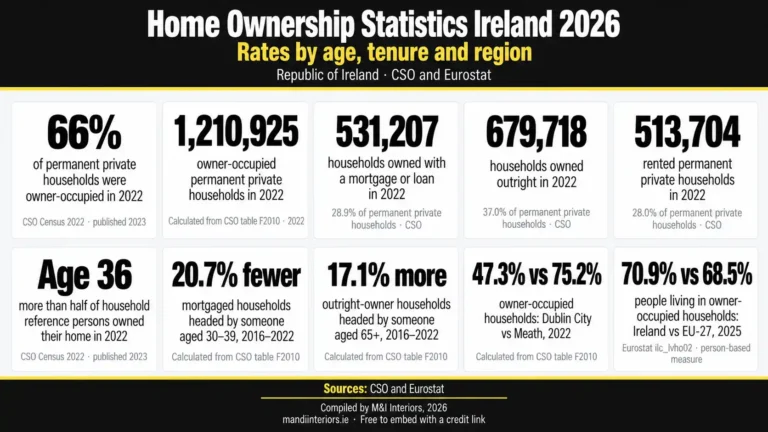
Online Home-Furnishings Shopping Statistics Ireland 2026
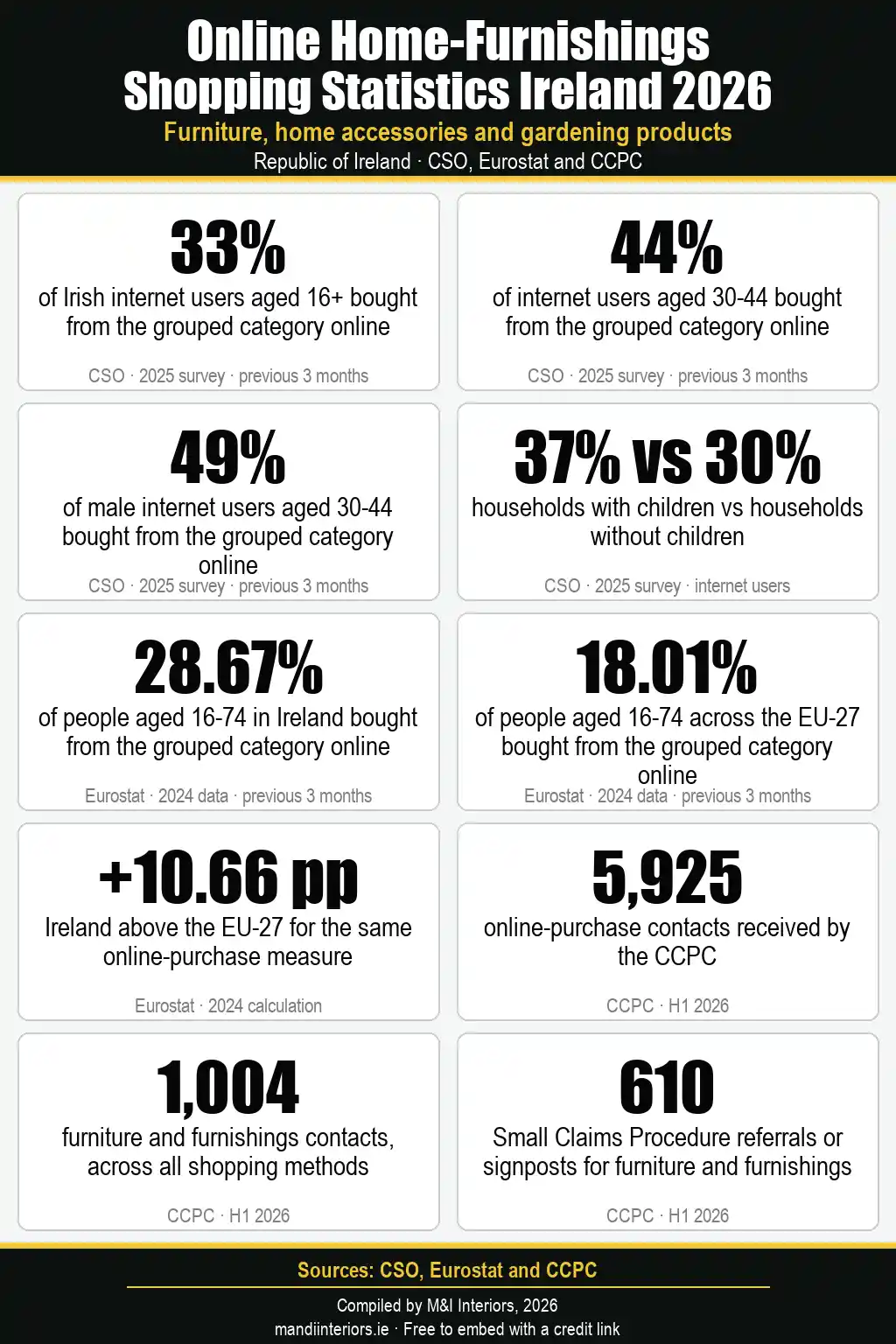
Free to embed. Please credit M&I Interiors with a link to this page: https://mandiinteriors.ie/online-home-furnishings-shopping-statistics-ireland/
What the official online-purchase category measures
The most important limitation is the wording of the survey category. The CSO and Eurostat ask about purchases of furniture, home accessories or gardening products. Eurostat’s documentation gives carpets and curtains as examples of home accessories, while gardening products can include tools and plants.
The figures therefore describe a broad household-goods category. They do not reveal how many people bought sofas, beds, dining sets or curtains specifically. They also do not measure transaction totals, spending, average order value, delivery method or the share bought from Irish retailers.
The reference period is also short. Respondents were asked about purchases made during the previous three months, not throughout the full calendar year. A person who bought several products is counted in the same way as someone who made one qualifying purchase, and respondents could select more than one product category.
How many people in Ireland buy home-related products online?
In the 2025 CSO survey, 33% of internet users aged 16 and over reported buying furniture, home accessories or gardening products online during the previous three months. The figure covers internet users rather than every resident, so it should not be presented as one-third of the entire Irish population. CSO purchase table
The overall figure was unchanged at the published whole-percentage level from 2024, when the CSO also reported 33%. The rounded percentages do not establish that the underlying estimates were exactly identical. Survey estimates can move within a range even when the displayed whole number stays the same. CSO household table
For wider spending and retail context, M&I’s furniture statistics roundup separately covers Irish household expenditure, retail sales, prices, affordability and reuse. Those measures answer different questions and should not be combined with the online-purchase percentage to estimate a market size.
Online purchases by age
Internet users aged 30 to 44 had the highest all-sex percentage in the 2025 CSO table. In this age group, 44% bought furniture, home accessories or gardening products online in the previous three months. CSO purchase table
The corresponding figure was 36% among internet users aged 45 to 59. It was 25% for those aged 60 to 74 and 17% for people aged 16 to 29. CSO purchase table
Among internet users aged 75 and over, the reported share was 36%. This figure applies only to people in that age group who used the internet during the previous three months. It is not an estimate for everyone aged 75 or older, and it cannot be compared directly with Eurostat’s standard 16 to 74 population. CSO purchase table
The age pattern is descriptive. The data do not establish why the percentages differ. Household formation, replacement needs, income, access to shops, digital confidence and the types of products included may all be relevant, but the purchase table does not test those explanations.
Differences between male and female internet users
Across all ages, 35% of male internet users and 30% of female internet users bought from the grouped category online in the 2025 survey. These percentages describe reported purchase activity and do not show how much either group spent. CSO purchase table
The largest percentage in the age-and-sex table was among men aged 30 to 44, at 49%. The figure for women in the same age group was 39%. Among those aged 45 to 59, the respective percentages were 40% for men and 33% for women. CSO purchase table
For internet users aged 60 to 74, the percentages were 29% for men and 22% for women. Among internet users aged 75 and over, they were 39% and 30% respectively. CSO purchase table
The youngest age group showed a different pattern. Among internet users aged 16 to 29, 14% of men and 20% of women reported buying from the category. These are subgroup survey estimates, so small differences should not be sharpened into broad claims about shopping preferences without uncertainty measures. CSO purchase table
Households with and without children
In 2025, 37% of internet users in households with children bought furniture, home accessories or gardening products online during the previous three months. The comparable figure for internet users in households without children was 30%. CSO household table
The published 2024 figures were 37% for households with children and 31% for households without children. This means the displayed percentage for households with children remained at 37%, while the no-children figure moved from 31% to 30%. Because these are rounded survey estimates, the results should be described without implying exact stability or a precisely measured one-point decline. CSO household table
Household composition is not the same as parental status, and the table does not say which household member selected or used the product. It also does not separate purchases made for children from purchases made for shared rooms, gardens or the adults themselves.
How Ireland’s online purchasing changed from 2020 to 2024
Eurostat provides a harmonised series for people aged 16 to 74. On that basis, 16.46% of people in Ireland bought furniture, home accessories or gardening products online during the previous three months in 2020. By 2024, the figure was 28.67%. Eurostat dataset
That is an increase of 12.21 percentage points, calculated from the two Eurostat values. It is a change in the share of people reporting a qualifying purchase, not a 12.21% increase in sales, spending or transaction volume. Eurostat dataset
The series should not be used to claim that the pandemic permanently caused the increase. It records how the percentage changed, but it does not isolate the effect of restrictions, retailer investment, delivery availability, household moves or other possible influences.
Consumer contacts about online purchases and furniture
The CCPC’s helpline data provide a different view of online retail. During the first half of 2026, the organisation received 5,925 contacts about online purchases. The CCPC reported that this was 34% higher than in H1 2025. CCPC helpline report
Where the location of the online business was supplied, 73% of contacts concerned businesses based in Ireland. Businesses in the UK accounted for 8%, businesses elsewhere in the EU for 12%, and businesses in the rest of the world for 6%. The displayed shares do not total 100% because of rounding. CCPC helpline report
Across every shopping method, not online alone, the CCPC received 1,004 contacts about furniture and furnishings in H1 2026, compared with 644 in H1 2025. The same report recorded 610 referrals or signposts to the Small Claims Procedure in this sector. CCPC helpline report
These figures must not be treated as national complaint rates. A contact can involve a request for information or a report about a transaction or business. It does not show that the trader broke the law, that a claim was filed, or that a consumer received a judgment.
What the statistics do not reveal about furniture shopping
Neither the CSO nor Eurostat category identifies the retailer, website or country from which a product was bought. The purchase could have been made from an Irish shop, an international marketplace, a manufacturer selling directly, or a private seller. The category can also include used goods, so it should not be treated as a measure of demand for newly manufactured furniture.
The survey does not separate purchases made entirely online from journeys that began in a showroom or ended with an in-person visit. A customer may inspect a sofa in a shop and order it later through a website, or research a dining set online before completing the purchase in person. The published percentages record the qualifying online purchase, not every step that led to it.
Product scale is another limitation. A low-cost home accessory and a complete bedroom set both count as participation in the same broad category. The figures therefore cannot show whether online buyers are comfortable purchasing large furniture without seeing it, whether delivery and assembly influenced the choice, or whether the transaction involved a customised product.
These distinctions matter when the statistics are used by journalists or businesses. The data are strong evidence that online purchasing is established within a broad home-related category. They are not evidence that one-third of internet users bought furniture, that online channels account for one-third of furniture sales, or that online purchasing has replaced showrooms.
Ireland compared with the EU
The cleanest comparison comes from using the same Eurostat indicator for Ireland and the EU-27. In 2024, 28.67% of all people aged 16 to 74 in Ireland bought furniture, home accessories or gardening products online during the previous three months. The comparable EU-27 figure was 18.01%. Eurostat dataset
Ireland’s share was therefore 10.66 percentage points higher than the EU-27 figure. This is a comparison between aligned measures, but it does not by itself establish Ireland’s rank among individual countries. Eurostat dataset
Between 2020 and 2024, the comparable EU-27 percentage increased from an estimated 15.20% to 18.01%, a rise of 2.81 percentage points. Ireland’s increase over the same endpoints was larger, but the figures do not explain the reasons for the different changes. Eurostat dataset
Methodology and definitions
This roundup was compiled by M&I Interiors from primary sources reviewed on 24 November 2026. The main sources are the CSO’s Household Digital Consumer Behaviour 2025 release, Eurostat dataset isoc_ec_ibgs, and the CCPC’s H1 2026 helpline report.
The CSO percentages cover people aged 16 and over who used the internet during the previous three months. The Eurostat comparison covers all individuals aged 16 to 74. These are different denominators, so the CSO’s 33% should not be compared directly with the EU-27’s 18.01%. The Ireland and EU figures in the dedicated comparison section both come from Eurostat and use the same definition. CSO purchase table; Eurostat dataset
CSO survey percentages are subject to sampling and other survey errors, with relatively greater uncertainty around smaller values. The tables do not publish confidence intervals. CCPC figures are administrative counts of contacts and referrals. They do not estimate how common a problem is across the full population.
Calculated percentage-point differences use unrounded Eurostat values where available. No survey percentage has been converted into a population count, sales total or market-size estimate.
Shopping for furniture with M&I Interiors
M&I Interiors offers sofas and coordinated living, dining and bedroom furniture online and through its Portlaoise showroom. Customers who want to compare pieces, sizes and finishes can browse our furniture collections before visiting or arranging delivery.
For help bringing furniture, lighting, colour and window treatments together, the M&I interior design service includes room planning, furniture sourcing and 3D visualisation. The national statistics above provide context for online shopping in Ireland; they do not describe M&I customers or purchasing outcomes.
Related Irish home statistics
- See Irish furniture statistics for spending, retail sales, prices, reuse and affordability.
- See household textiles statistics for spending and price context covering household fabrics and related products.
- See Irish home-size statistics for floor area, room counts and household-space context.