
Household Textiles Statistics Ireland 2026: €518 Million in Household Spending
Sources reviewed 18 November 2026 | Approximately 12-minute read | Human written and fact checked against each named source.
Household textiles sit quietly in almost every room, from curtains and cushions to bedding, towels and table linen. Irish households spent an estimated €518 million on these products in 2025, while official price data show that different categories moved in very different directions during 2026.
This roundup was prepared in 2026, but the sources measure different periods. The newest spending estimate covers 2025, the latest price figures cover October 2026, the national behaviour survey was conducted in August 2024, and the matched Ireland and EU consumption comparison uses 2018 data. Those dates are kept beside the relevant figures so that older evidence is not presented as a current-year result.
Key household textile statistics
- Irish households spent €518 million on household textiles in 2025 at current prices, based on the CSO spending tables.
- Current-price spending increased by 4.0% between 2024 and 2025, calculated from the annual accounts figures.
- The real-volume measure increased by 8.6% in 2025, but this is a chain-linked estimate in 2024-reference prices, not cash spending, as shown in the CSO volume series.
- Household-textile prices were 1.9% lower year on year in October 2026, although they increased by 3.2% during that month, according to the October CPI release.
- Furnishing-fabric and curtain prices were 3.7% lower year on year in October 2026, based on the CSO price tables.
- 28% of surveyed Irish adults most often put unwanted household textiles in a textile bring bank, according to the EPA textiles survey.
- 16% most often put household textiles such as towels or cushions in the household waste bin, the same national survey found.
- Ireland’s apparent consumption of bed linen, towels and tablecloths was 2.6 kg per person in 2018, compared with 1.44 kg across EU-27 in the EPA consumption study.
- Ireland’s apparent consumption of curtains, drapes and other interior furnishings was 0.6 kg per person in 2018, close to the EU-27 figure of 0.65 kg in the same matched comparison.
- Household textiles accounted for 7 kg per person of EU textile consumption in 2022, according to a newer EEA textiles briefing.
Household Textiles Statistics Ireland 2026 Infographic
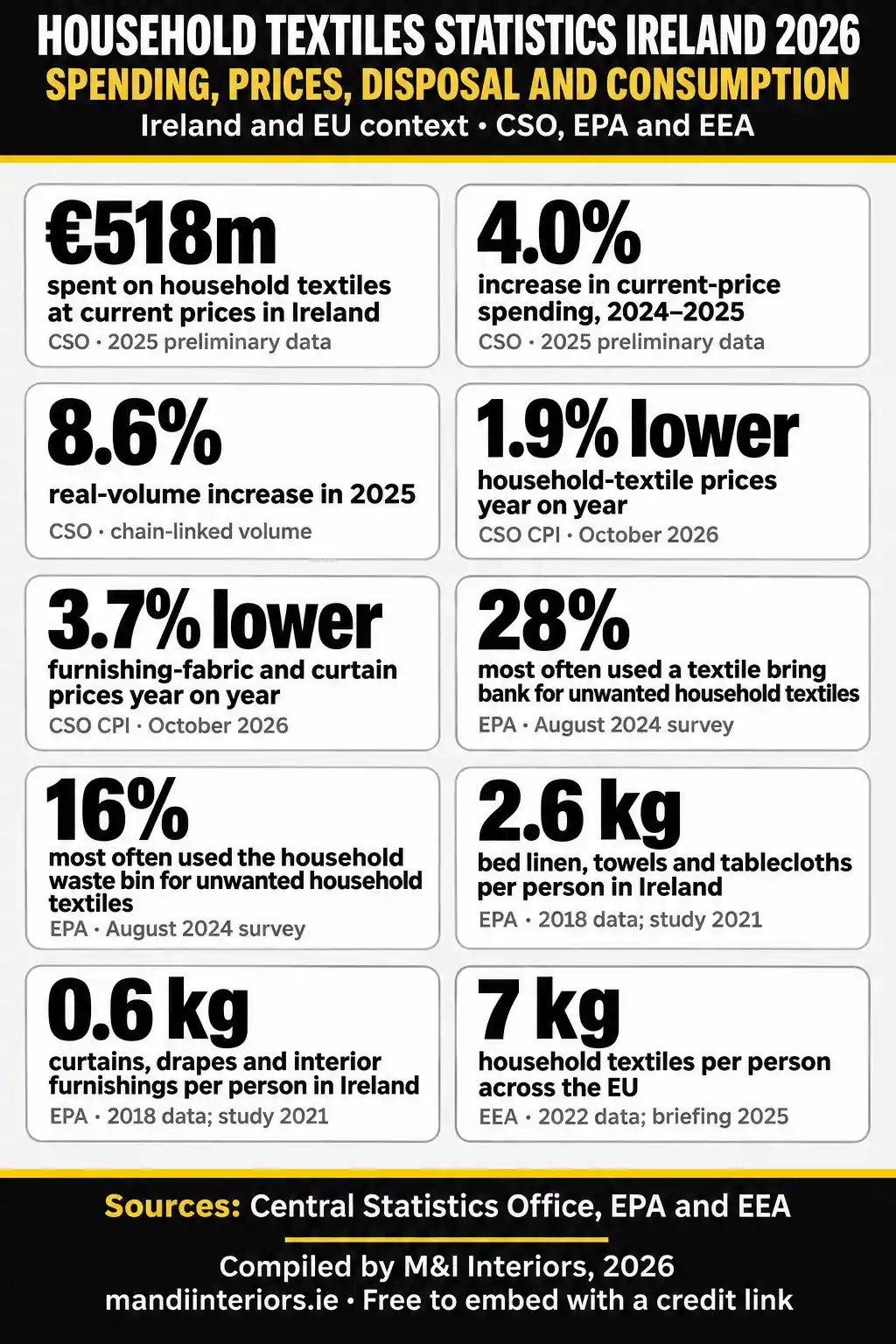
Free to embed. Please credit M&I Interiors with a link to this page: https://mandiinteriors.ie/household-textiles-statistics-ireland/
What counts as a household textile?
The household-textile category includes products used to furnish, protect and soften living spaces. In the CSO’s consumption classification, it sits within furnishings, household equipment and routine household maintenance. The category covers products such as furnishing fabrics, curtains, bed linen, bedding, table linen, bathroom linen and other household textiles.
Not every official source uses exactly the same boundary. The EPA consumption study groups products through customs codes, while the EPA behaviour survey asks people about specific examples such as towels, cushions, duvet covers and sheets. This means a figure about household textiles should not automatically be treated as a figure about clothing, carpets, furniture or every textile product used in a home.
Household textile spending in Ireland
Irish household spending on household textiles reached €518 million in 2025 at current prices. The comparable figure was €498 million in 2024, giving a nominal increase of 4.0%, calculated from the CSO national accounts. The 2025 estimate is preliminary and may be revised in a later release.
Current-price spending was €394 million in 2020, which means the 2025 estimate was 31.5% higher than the 2020 figure. This is a nominal comparison, so it reflects both price changes and changes in the quantity or mix of products purchased. It should not be interpreted as a 31.5% increase in the physical amount of household textiles bought.
Within the six years shown in the latest release, current-price spending reached €536 million in 2022. The 2025 figure was therefore 3.4% below the 2022 level, despite increasing during the most recent year. The same CSO series is used for both values, which avoids mixing figures from differently revised releases.
Household textiles represented approximately 8.7% of Ireland’s €5.983 billion in current-price spending on furnishings, household equipment and routine household maintenance in 2025. This is a share of that specific spending division, not a share of total household expenditure.
Spending and volume are not the same measure
The CSO also publishes a chain-linked volume series intended to show changes after removing price effects. In that series, the 2025 household-textile measure was €541 million in 2024-reference prices, up from 498 million in 2024. That produces an estimated real-volume increase of 8.6%, based on the chain-linked tables.
The €541 million value is not an estimate of how much money households handed over in 2025. It is a volume indicator expressed using reference-year prices. The current-price figure of €518 million is the appropriate statistic when describing household spending in euros. The chain-linked figure is useful when discussing the estimated change in purchasing volume.
Curtain, bedding and household linen prices
Household-textile prices as a whole increased by 3.2% during October 2026 but remained 1.9% lower than in October 2025. The different monthly and annual movements in the CSO CPI table are not contradictory because each compares October 2026 with a different base period.
Furnishing fabrics and curtains increased by just 0.2% during October and were 3.7% lower year on year. These are average price movements for the CPI category. They do not mean that every curtain, fabric, fitting or made-to-measure order changed by the same percentage.
Bed linen and bedding recorded the largest monthly increase among the named household-textile groups, rising by 4.5% in October 2026. Prices were still 0.9% lower year on year. Table linen and bathroom linen increased by 3.5% during the month and were 2.9% lower than a year earlier, according to the same official price release.
The residual category labelled other household textiles increased by 1.4% during October and was unchanged year on year on the published rounded measure. CPI figures measure price change in a representative basket. They do not measure retail sales, household demand or the quality of products being purchased.
How people dispose of bedding and household textiles
The EPA’s second national textiles survey asked 1,069 adults aged 16 and over what they most often did with different types of unwanted textiles. Fieldwork was completed online in August 2024 using a nationally representative sample. The results describe self-reported behaviour rather than measured waste tonnage.
For household textiles such as towels and cushions, 28% most often used a textile bring bank. A further 16% most often used the household waste bin, while 7% most often placed the items in the household recycling bin, according to the EPA survey report. Textiles are not a target material for the household recycling bin.
Bedding produced a similar pattern. For items such as duvet covers and sheets, 28% most often used a textile bring bank, 15% used the household waste bin and 8% used the household recycling bin. These figures refer to the option respondents selected as their most common action, not every route they had ever used.
Across all the clothing and textile types included in the question, an average of 40% most often donated items to a charity shop. An average of 23% used a textile bring bank and 14% passed items to family or friends. These wider EPA behaviour figures also include clothing, footwear and accessories, so they should not be reported as household-textile-only results.
Household textile consumption by product type
An EPA study published in 2021 estimated apparent consumption using production and trade data. Apparent consumption is broadly calculated from production plus imports minus exports. It is not a direct survey of what each household bought, and the report stresses that textile-flow estimates contain uncertainty.
In 2018, Ireland’s apparent consumption of blankets and travelling rugs was 2,463 tonnes, equivalent to 0.5 kg per person. Bed linen, towels and tablecloths formed the largest of the three household-textile groups shown, at 12,694 tonnes or 2.6 kg per person. Curtains, drapes and other interior furnishings accounted for 2,974 tonnes or 0.6 kg per person, based on the EPA flow study.
Together, those three specified groups totalled 18,131 tonnes. Their rounded per-person values add to approximately 3.7 kg per person. This derived total is useful for orientation, but it covers only the customs-code groups in the table and should not be described as every household textile consumed in Ireland.
The same study estimated Ireland’s net consumption of all new textiles at 263,000 tonnes, or 53 kg per person, in 2019. That much broader estimate includes more than household textiles, so it is not an Irish household-textile market-size figure.
Ireland compared with the EU
The most defensible Ireland and EU comparison comes from the same 2018 table and uses matched product categories. Ireland recorded 0.5 kg per person for blankets and travelling rugs, compared with 0.27 kg across EU-27. For bed linen, towels and tablecloths, the Irish estimate was 2.6 kg per person, compared with 1.44 kg across EU-27, according to the matched EPA table.
The position was different for curtains, drapes and other interior furnishings. Ireland’s estimate of 0.6 kg per person was close to the EU-27 figure of 0.65 kg. The evidence therefore does not support a simple claim that Ireland was higher across every household-textile category.
The three specified groups add to approximately 3.7 kg per person in Ireland and 2.36 kg across EU-27. Both totals are derived from rounded category figures and should be treated as approximate. Clothing plus the specified household-textile groups totalled 20.3 kg per person in Ireland and 12.3 kg across EU-27, but that broader comparison is not a household-textile-only measure.
A newer EEA briefing estimates that EU apparent consumption reached 19 kg of textiles per person in 2022, comprising 8 kg of clothing, 7 kg of household textiles and 4 kg of footwear. Household textiles also represented 21% by weight of the EU’s 11 million tonnes of textile-product imports in 2022, according to the EEA briefing. These newer EU figures should not be directly subtracted from the 2018 Irish estimates because the periods and product coverage differ.
Methodology and sources
This roundup was compiled from primary-source publications reviewed on 18 November 2026. Spending and volume figures come from the CSO Annual National Accounts 2025. Price movements come from the CSO Consumer Price Index for October 2026. Disposal behaviour comes from the EPA’s second national survey, based on online fieldwork among 1,069 adults aged 16 and over in August 2024.
Historical Irish and EU consumption comparisons come from the EPA’s Nature and Extent of Post-Consumer Textiles in Ireland study. The matched category table uses 2018 apparent-consumption data, while its broader Irish new-textiles estimate relates to 2019. Newer EU context comes from the European Environment Agency’s 2025 briefing, which mainly reports 2022 data.
Calculated percentages use values from the same table and price basis. Current-price expenditure and chain-linked volume are reported separately. Survey percentages remain self-reported estimates, and confidence intervals were not published in the cited report. Per-capita household-textile totals derived from the EPA comparison are labelled approximate because the source components are rounded.
Creating a considered interior
Statistics describe national spending, prices and behaviour, but they cannot determine which fabric, dimensions or finish will work in an individual room. M&I Interiors helps Irish households coordinate furniture, fabrics and finishes through its interior design service and curated collection of curtains and fabrics. The aim is to create a coherent home rather than to treat each purchase as an isolated item.
Related Irish home statistics
For wider context on how Irish households furnish their homes, see M&I Interiors’ roundup of furniture statistics Ireland. The related article covers furniture spending, purchasing and market context without combining those figures with the household-textile category used here.
For online purchasing across the broader household-goods category, see our online home-furnishings statistics.