
Self-Build Statistics Ireland 2026: One-Off Homes from Planning to Completion
Sources reviewed 06 October 2026 | Approximately 12-minute read | Human written and fact checked against each named source.
Building a one-off home is an important part of Ireland’s housing story, but there is no single official series that counts every “self-build” from initial idea to finished house. Planning permissions, commencement notices, electricity-connected completions and Help to Buy claims each measure a different stage or population.
This page was prepared in 2026 using the newest suitable official releases available on 6 October 2026. Some figures cover the full year 2025, while the newest 2026 data cover either the first half or the first eight months of the year. Those partial-year figures are labelled clearly and are not forecasts of the final 2026 total.
Key self-build and one-off housing statistics
- Irish planning authorities granted permission for 5,095 one-off houses in 2025, up 3.9% from 4,906 in 2024, according to the CSO planning release.
- The first half of 2026 recorded 2,611 one-off house permissions, which was 9.4% higher than the same period of 2025, calculated from the CSO quarterly tables.
- A one-off house granted permission in Q2 2026 had an average planned floor area of 221.6 square metres, compared with 119.8 square metres for a multi-development house in the CSO floor-area data.
- Ireland recorded 5,874 single-dwelling completions in 2025, the highest annual total in the CSO series beginning in 2011, based on the CSO completions series.
- The first half of 2026 produced 2,838 single-dwelling completions, 9.7% more than the first half of 2025, calculated from the CSO completion table.
- Commencement notices covered 3,094 one-off or single-dwelling units from January to August 2026, an increase of 26.7% from the same eight months of 2025, based on the Department commencement dataset.
- Revenue approved 1,703 Help to Buy self-build claims in 2025, representing 17.79% of all approved claims in the Revenue annual report.
- About 52% of approved one-off houses commenced within one year, 63% within two years and 70% within four and a half years in the Central Bank analysis of approval cohorts from 2016 to 2021.
- The median on-site construction stage for one-off houses increased from 13 months to around 25 months in the Central Bank project data.
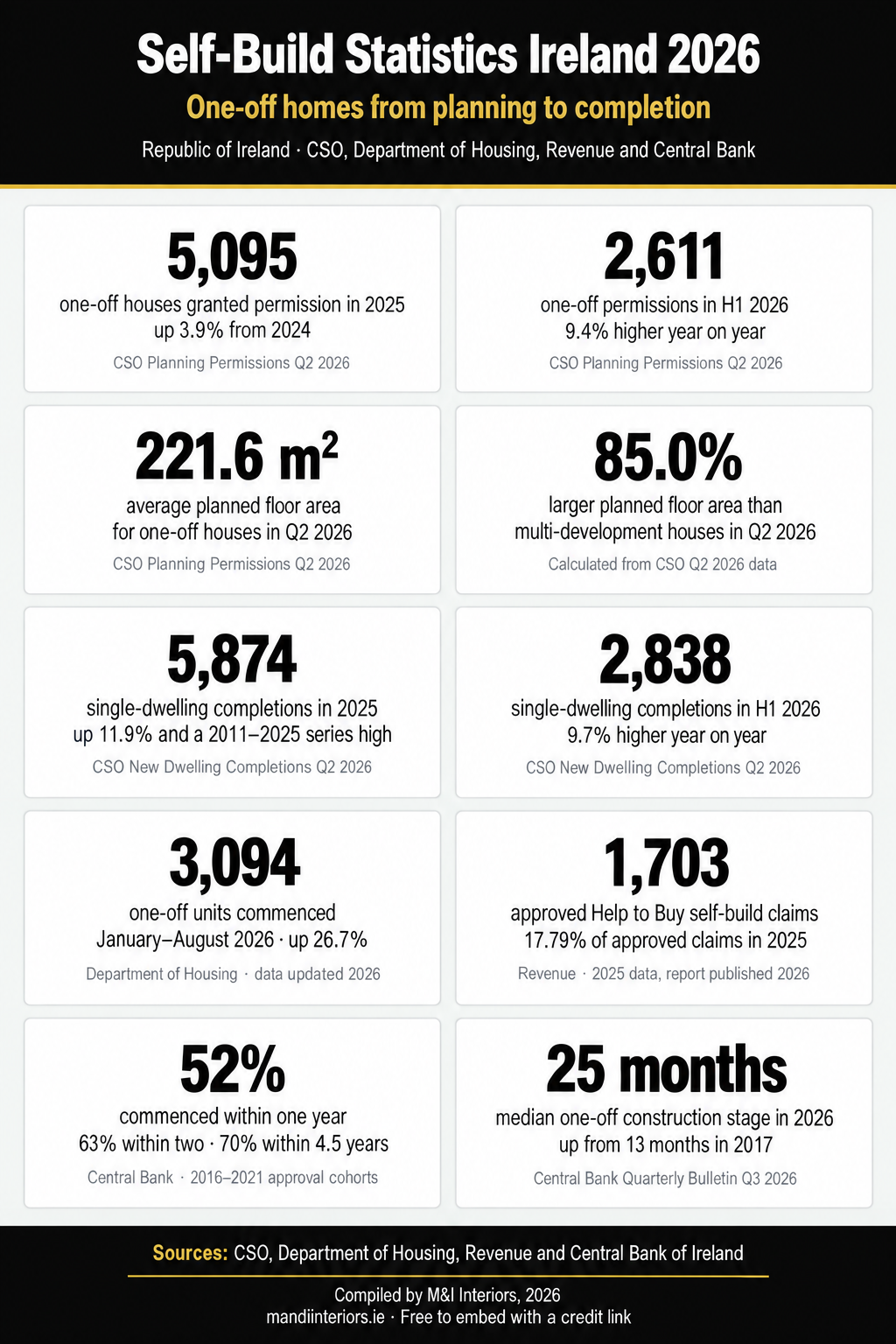
Free to embed. Please credit M&I Interiors with a link to this page: https://mandiinteriors.ie/self-build-statistics-ireland-2026/
What counts as a self-build home in these statistics?
The terms used in everyday conversation do not align perfectly with the labels used in official data. This matters because combining unlike figures could exaggerate or understate the scale of self-building.
The CSO’s planning-permission tables use the category one-off house. These figures count units that received planning permission, not projects that started on site or homes that were completed. The Department of Housing’s commencement dataset uses the category Oneoffs and describes it as single or one-off units covered by commencement notices.
For completions, the CSO uses single dwelling. Its new-dwelling series is based primarily on ESB Networks domestic electricity connections, with CSO adjustments and validation. A single dwelling is treated as a one-off dwelling in that series, but the category does not establish whether the future occupier personally managed the building project.
Revenue’s Help to Buy data is the narrowest source used here because it explicitly labels approved claims as either purchased or self-build. It measures participation in a tax-support scheme, not the total number of self-build projects nationally. The Central Bank’s linked-project analysis describes one-off houses as self-build houses, but its timelines are analytical measures drawn from linked planning and building-control records rather than the CSO’s aggregate counts.
For that reason, this article follows the pipeline in sequence: one-off planning permission, one-off or single-dwelling commencement, single-dwelling completion, and approved Help to Buy self-build claim. The figures are never added together.
One-off planning permissions increased in 2025 and early 2026
The CSO planning tables show that planning authorities granted permission for 5,095 one-off houses during 2025, compared with 4,906 in 2024, an annual increase of 3.9%. The same CSO release records an average planned floor area of 224.6 square metres for one-off houses permitted during 2025.
The upward movement continued into the available 2026 data. The CSO quarterly figures show 1,382 one-off house permissions in Q1 2026 and 1,229 in Q2, giving a first-half total of 2,611. The equivalent quarters of 2025 recorded 1,230 and 1,157 respectively, so the first-half total increased by 9.4%, based on the same CSO quarterly figures.
The second-quarter result should still be read cautiously. One-off permissions increased by 6.2% year on year in Q2 2026, but the CSO release warns that quarterly permission totals can be volatile and should not be used alone to infer a long-term trend. Permission also represents an approval rather than a guarantee that building work will commence.
Permitted one-off homes have substantially more floor area
The floor-area data provides one of the clearest ways to understand the design context of an Irish one-off home. In Q2 2026, the average one-off house granted permission had 221.6 square metres of planned floor area, compared with 119.8 square metres for a multi-development house in the CSO dwelling table.
On those same-quarter figures, the permitted one-off home was 85.0% larger on average. This is a calculated comparison, using (221.6 ÷ 119.8 − 1) × 100, rather than a percentage published directly by the CSO. It compares average planned floor area, not the final measured size or quality of individual completed homes.
One-off houses also made up 19.6% of all house units granted permission in Q2 2026, calculated as 1,229 of 6,275 house units in the CSO headline table. Apartments are excluded from that denominator, so the percentage should not be described as the one-off share of all dwelling permissions.
Single-dwelling completions reached a series high in 2025
The CSO completions table records 5,874 single-dwelling completions in 2025, up from 5,247 in 2024. That equates to a calculated increase of 11.9%, using the revised historical values in the same CSO table.
The 2025 figure was the highest annual total in the current CSO completion series, which begins in 2011. It should be described as a series high, not an all-time Irish record. Single dwellings represented 16.2% of all 36,215 dwelling completions in 2025, based on the same CSO table.
The CSO quarterly series records 2,838 single-dwelling completions in the first half of 2026, comprising 1,411 in Q1 and 1,427 in Q2. The comparable first-half 2025 total was 2,588, so completions were 9.7% higher year on year, calculated from the same quarterly series.
The quarterly pattern was uneven. The 1,427 single dwellings completed in Q2 2026 were 3.7% fewer than the 1,482 recorded in Q2 2025 in the CSO key findings. Single dwellings accounted for 16% of all 8,823 completions during Q2 2026, as reported in the same findings.
Regionally, the South-West, comprising Cork and Kerry, recorded 239 single-dwelling completions in Q2 2026, the most among the regions in the CSO regional data for that quarter. This is a regional result and should not be presented as a county total.
One-off commencements rose during the first eight months of 2026
Commencement notices covered 3,771 one-off or single-dwelling units in 2025, according to the Department of Housing’s commencement dataset. A commencement notice is an administrative step that must precede building work. It is not evidence that every unit was subsequently completed.
From January through August 2026, the Department dataset recorded 3,094 one-off or single-dwelling units, compared with 2,442 in the same eight months of 2025, a calculated year-on-year increase of 26.7%. These units represented 13.5% of the 22,854 total residential units covered by commencement notices during the first eight months of 2026 in the same dataset.
The local-authority figures show where this part of the pipeline was most active. From January through August 2026, Galway County recorded 349 one-off commencements, followed by Donegal County with 339 and Cork County with 331, calculated from the Department’s monthly fields. Cork City is recorded separately from Cork County in the dataset.
These are year-to-date administrative figures from a dataset updated on 17 September 2026. They should not be annualised mechanically because the monthly timing of notices can vary and policy deadlines can shift activity between periods.
Help to Buy provides a narrower self-build measure
Revenue approved 1,703 Help to Buy claims for self-builds in 2025, representing 17.79% of 9,575 approved claims, while purchased homes accounted for the remainder in the Revenue annual report.
The monthly Revenue dataset recorded 1,030 approved self-build claims from January through August 2026. Purchased claims totalled 5,948 over the same months, giving 6,978 claims overall and a calculated self-build share of 14.8%, based on the Revenue build-type data.
Monthly approved self-build claims ranged from 99 in February to 175 in July during those eight months in the Revenue monthly data. This is useful evidence about use of the scheme, but it cannot be expanded into an estimate of all self-build homes. Eligibility rules and a household’s decision to claim determine the population covered.
The route from permission to completion has lengthened
The Central Bank’s linked-project analysis helps explain why planning approvals and completed homes cannot be compared as if they occurred in the same period. Among one-off houses approved from 2016 to 2021 and observed for at least four and a half years, 52% commenced within one year, 63% within two years, and 70% within four and a half years, according to the Central Bank bulletin.
The median time from planning approval to commencement for one-off houses increased from about six months in 2017 to 10 months in 2026, according to the Central Bank analysis. Once on site, the median construction stage increased from 13 months to around 25 months in the same analysis.
Looking across all housing types, homes completed up to 29 August 2026 took a median of 44 to 50 months from planning application to completion, depending on build type, in the Central Bank project data.
The bulletin reports that one-off houses and apartments took around two and a half times as long as in 2017. The same analysis found that 25% to 32% of units granted permission in each year from 2017 to 2020 lapsed without construction commencing within the following five years.
These figures are medians and cumulative conversion shares from linked project records. They are not directly interchangeable with the CSO’s national permission or completion totals. The Central Bank also notes limitations in completion-date coverage, particularly for one-off houses, so the approximate wording should be retained.
Methodology and sources
This roundup was compiled on 6 October 2026 from six primary-source publications or datasets: CSO Planning Permissions Q2 2026, CSO New Dwelling Completions Q2 2026, the Department of Housing’s monthly Residential Commencement Notices dataset, Revenue’s 2025 Help to Buy annual report, Revenue’s monthly Help to Buy build-type dataset, and the Central Bank of Ireland’s Quarterly Bulletin Q3 2026.
Full-year 2025 figures are used where a completed annual period is available. The latest 2026 planning and completion comparisons cover January to June, while commencement and monthly Help to Buy comparisons cover January to August. No partial-year figure is presented as an estimate of the full-year result.
Calculated percentages use compatible values from the same source, definition and period. Results are rounded to one decimal place unless the authority publishes a different precision. The 9.4% first-half permission change compares 2,611 in 2026 with 2,387 in 2025 using the CSO planning data.
The 9.7% completion change compares 2,838 with 2,588 in the CSO completion data. The 26.7% commencement change compares 3,094 with 2,442 in the Department dataset. The 85.0% floor-area difference compares 221.6 with 119.8 square metres in the CSO planning table.
How M&I Interiors Can Help
The statistics do not prescribe how an individual home should be designed. They do show why interior decisions are often part of a much longer project rather than a final decorative step.
An average planned floor area of 221.6 square metres for one-off permissions in Q2 2026, documented in the CSO planning data, can involve several connected decisions about circulation, room proportions, furniture scale, lighting positions, window treatments and storage.
The Central Bank finding that the on-site stage for one-off houses had risen to around 25 months also means product availability, lead times and changing requirements may need to be revisited as a project progresses.
M&I Interiors’ interior design services include space planning, colour consultation, three-dimensional visualisation, sourcing and implementation. For a new-build project, beginning those conversations while layouts and electrical points can still be reviewed may help keep furniture, lighting and finishes aligned with the intended use of each room.
This is practical design guidance, not a claim that interior planning changes construction or completion outcomes.