
Irish Design Industry Statistics 2026: 3,411 Specialised-Design Enterprises
Sources reviewed 10 November 2026 | Approximately 12-minute read | Human written and fact checked against each named source.
Ireland’s design economy includes far more than one occupation or type of studio. Eurostat counted 3,411 specialised-design enterprises in Ireland in 2024, while a nationwide survey by the Institute of Designers in Ireland received responses from people working across 43 design disciplines.
This article brings the available figures together without treating different populations as interchangeable. It was compiled in 2026, but its newest business data measures 2024. Other evidence covers design work in 2024, client activity in 2023, the combined design-and-craft sector in 2022, and a historical government study covering 2011 to 2014.
Irish design industry statistics at a glance
- Eurostat recorded 3,411 specialised-design enterprises in Ireland in 2024.
- Those enterprises had 5,580 persons employed, including employees, working proprietors and other covered non-employee workers.
- Eurostat separately counted 3,160 employees in Ireland’s specialised-design enterprises in 2024.
- Specialised-design enterprises generated €809.07 million in turnover in 2024.
- The same businesses generated €341.15 million in value added in 2024.
- The Institute of Designers in Ireland received 1,456 survey responses between 12 January and 1 March 2024.
- Interior design was the primary discipline selected by 80 IDI respondents. This is a voluntary survey count, not a national estimate.
- Across the IDI survey, 45% worked hybrid, 31% worked fully remotely and 19% worked fully onsite.
- DCCI estimated that about 63,000 people worked directly in Ireland’s combined design-and-craft sector in 2022.
- Apparent labour productivity in specialised design was €61,140 per person employed in Ireland in 2024, compared with €40,910 across the EU-27.
Irish Design Industry Statistics 2026 Infographic
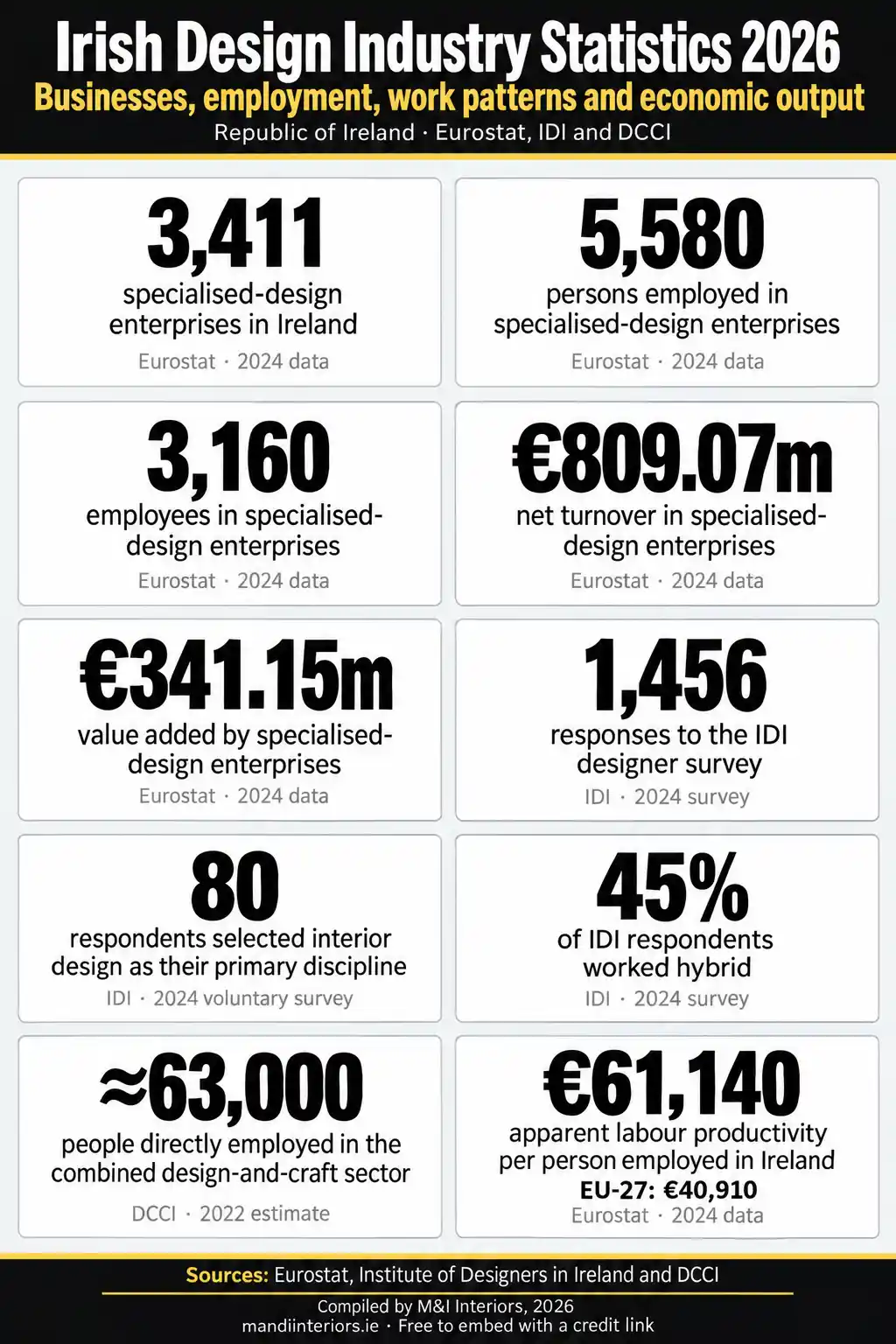
Free to embed. Please credit M&I Interiors with a link to this page: https://mandiinteriors.ie/irish-design-industry-statistics-ireland/
What counts as specialised design?
The main business figures in this roundup use Eurostat’s NACE Rev. 2 group M741, called specialised design activities. This is an enterprise classification, not a list of individual job titles. It groups businesses by their main economic activity and covers more than interior design.
That distinction matters because a specialist interiors studio, a graphic-design business and another type of design enterprise can appear inside the same broad group. The 2024 Eurostat totals cannot be described as a count of interior-design firms or interior designers.
A newer classification will eventually make the picture more detailed. NACE Rev. 2.1, which Eurostat says is used from 2025 onward, divides specialised design into industrial product and fashion design, graphic design and visual communication, interior design, and other specialised design activities. Interior design receives its own code, 74.13. At the time of this review, however, the current annual Irish business series still reported the broader M741 group through 2024.
How many specialised-design businesses and workers are there?
Ireland had 3,411 specialised-design enterprises in 2024. This is a business-statistics total rather than a directory of named design practices. An enterprise is assigned according to its main activity, which means the series may not capture every designer working inside a retailer, manufacturer, architectural practice or other organisation whose main activity sits elsewhere.
Those enterprises had 5,580 persons employed in 2024. Eurostat’s persons-employed measure is deliberately broader than employees because it can include working proprietors and other people working in the enterprise who are not on the employee count.
The narrower employee total was 3,160 in 2024. Employees therefore represented 56.63% of persons employed in the sector. The remaining share should not automatically be labelled freelance designers because the statistical definition covers several non-employee working arrangements.
Eurostat reported two persons employed per specialised-design enterprise in Ireland in 2024. Employment increased by 2.24% between 2023 and 2024. This annual movement is useful context, but it does not establish a long-term forecast or show that every design discipline expanded at the same rate.
The difference between enterprises, persons employed and employees also helps explain the structure of the activity group. A business can be counted as an enterprise while having a working proprietor and few or no employees. The published statistics therefore support a picture of a sector containing many small operations, but they do not reveal whether those businesses serve residential, commercial, digital, fashion or other design markets.
Turnover, value added and productivity
Net turnover in Ireland’s specialised-design enterprises reached €809.07 million in 2024. Turnover per person employed was €144,990. Neither measure is average pay, and turnover should not be presented as the size of the interior-design market.
Value added was €341.15 million in 2024. Apparent labour productivity, which measures value added per person employed, was €61,140. Aggregate wages and salaries totalled €131.79 million.
Turnover and value added answer different questions. Turnover records the enterprise’s income from sales after the adjustments used by the statistical series. Value added measures the economic value created after relevant purchased inputs are removed. A high turnover figure can therefore coexist with a much lower value-added figure, and neither measure says what one household paid for a design service.
These values describe enterprise accounts within a statistical activity group. They do not show what an individual designer earns, what a household spends on interior design or what a particular project costs. For a separate consumer and retail view, M&I Interiors’ Irish furniture statistics cover furniture spending, retail sales, prices, affordability and reuse.
Where interior design appears in the survey evidence
The Institute of Designers in Ireland’s I Am A Designer report provides the clearest direct evidence about interior design within the wider profession. The survey was distributed through online channels and received 1,456 responses between 12 January and 1 March 2024. Respondents selected one primary discipline, even though the report acknowledges that many designers work across several fields.
The survey identified 43 design disciplines. Graphic design was the largest of the eight leading roles shown, with 437 respondents. Brand design followed with 133, user-experience design with 96 and interior design with 80. Digital product design accounted for 59 respondents, fashion design 56, illustration 44 and service design 31.
The 80 interior-design responses demonstrate that the discipline formed a visible part of the survey, but they do not measure the number of interior designers working in Ireland. The survey used voluntary online participation, did not publish a national sampling frame and did not provide a confidence interval for a population estimate.
IDI also found that interior designers were more likely to work alone or in small teams and that the discipline had a higher representation in Dublin than outside it. These are survey patterns rather than counts of businesses by county.
The survey is valuable because it identifies disciplines and working arrangements that are hidden inside broader business classifications. Its limitation is that people who encountered and chose to answer an online professional survey may differ from designers who did not. The role counts are best used to describe the respondent group, while Eurostat remains the stronger source for annual enterprise and employment totals.
How designers work
Hybrid work was the most common location pattern in the IDI survey, reported by 45% of respondents. A further 31% worked fully remotely and 19% worked fully onsite. Those three categories total 95%, so the unreported remainder should not be assigned to another work pattern without the underlying response data.
Freelancers and solopreneurs together represented 35% of respondents. The report says the two groups were almost equal in size but does not publish an exact split. Agency or consultancy practice accounted for 24% of respondents. The report also identified designers working in in-house teams for organisations whose main activity was not design.
Remote work varied by working arrangement. The survey found that 62% of freelance designers worked remotely, compared with 24% of all other designers. The report also associated smaller organisations with more remote work and larger organisations with hybrid working, particularly in fields such as user experience, service design and interaction design.
These patterns describe where respondents performed their work, not the location of the clients or spaces being designed. An interior designer can complete planning and visualisation remotely while still visiting a home, showroom or installation site. The figures should not be used to suggest that design delivery has become entirely digital.
The broader design-and-craft economy
Design & Crafts Council Ireland uses a wider economic definition than Eurostat’s specialised-design group. Its May 2024 update estimated that approximately 63,000 people were directly employed in the combined design-and-craft sector in 2022. That represented 2.4% of employment in Ireland, and the estimated total had increased by 7.4% between 2020 and 2022.
DCCI estimated that about 21,000 design-and-craft enterprises were operating in Ireland, including approximately 14,000 design-related enterprises and 7,000 craft enterprises. These rounded estimates use a broader sector definition than the 3,411 enterprises in Eurostat’s specialised-design category, so the totals should not be compared as if one were a subset calculated on the same basis.
The combined sector generated an estimated €11.3 billion in turnover in 2022, 9.7% more than in 2020. Its estimated gross value added was €4.2 billion, equal to about 1.2% of Irish GVA. These are design-and-craft figures, not estimates for interior design alone.
DCCI’s separate Annual Client Economic Survey reviewed 2023 activity among 560 client businesses. Of those respondents, 79% had sold products online, while 60% were increasing their focus on the domestic market through retail distribution. The top 150 clients recorded €81.3 million in domestic sales, almost 7% more than the €76.1 million reported for 2022. Survey respondents reported €28.6 million in combined exports to the EU and North America.
The DCCI client survey is especially relevant to product-based designers and craftspeople. Its online-sales finding should not be transferred automatically to service-only design practices. The sales and export totals also describe responding clients or the named top-client cohort rather than every business in the wider sector.
A historical view of Ireland’s design workforce
The Department of Jobs, Enterprise and Innovation published a broad Irish Design Footprint in January 2016. Its bespoke definition counted 48,047 people in design occupations in 2014, equal to 2.48% of total Irish employment. Advertising design was excluded from that headline employment series.
The report’s summary states that employment in its defined design occupations increased by 6.7% between 2011 and 2014. Digital design accounted for 48% of the total in 2014.
These figures are useful as historical context, but their occupation-based population differs from Eurostat’s enterprise series and DCCI’s combined design-and-craft estimates. They should not be joined into a single trend line.
The historical study also illustrates why a single number for “the design industry” can be misleading. An occupation-based approach follows people performing selected design roles across the economy. An activity-based approach follows enterprises whose main business is classified as design. A sector-impact study can use a wider model again. Each can be valid for its own question, but the resulting totals are not substitutes for one another.
Ireland compared with the EU
Eurostat’s 2024 structural-business data allow three direct comparisons using the same specialised-design activity, period and unit. Ireland recorded two persons employed per enterprise, compared with one across the EU-27. Both are rounded published values.
Apparent labour productivity was €61,140 per person employed in Ireland and €40,910 across the EU-27. Employees represented 56.63% of persons employed in Ireland’s specialised-design enterprises, compared with 36.56% across the EU-27.
These comparisons do not establish an Irish ranking. They also do not isolate interior design because both sides use the broader NACE Rev. 2 M741 activity group.
Methodology and sources
Sources were reviewed on 10 November 2026. The newest business figures come from Eurostat’s Structural Business Statistics dataset for 2024, updated on 30 September 2026. The business population is NACE Rev. 2 M741 specialised design activities. The article keeps enterprises, persons employed and employees separate and uses Eurostat’s published accounting indicators without converting turnover or value added into a market-size claim.
Working-pattern and discipline figures come from the Institute of Designers in Ireland’s voluntary online survey, conducted from 12 January to 1 March 2024 and published in November 2024. The 1,456 responses are described as survey responses, not a representative national estimate.
The wider economic estimates come from DCCI’s May 2024 release, based on a Grant Thornton update for 2022 and a Market Dynamics survey of 560 DCCI clients covering 2023 activity. Those results refer to design and craft together. Historical workforce context comes from the Department of Jobs, Enterprise and Innovation’s January 2016 report using 2011 to 2014 data.
The EU comparison uses the EU-27 aggregate from the same Eurostat dataset and keeps the activity code, reference year and units aligned. No comparison is made between Eurostat’s specialised-design measures and DCCI’s broader design-and-craft estimates. Values described as approximate remain approximate, and survey counts are not converted into population estimates.
No figures from private business directories were used. No Irish ranking was inferred from the EU comparison, and no broad design, craft or specialised-design number was relabelled as an interior-design total.
How M&I Interiors can help
Statistics describe the sector, but a successful room still depends on the people using it, the available space and the decisions made together. M&I Interiors provides interior design in Laois, including room and space planning, colour and finishes, furniture and décor sourcing, curtains and blinds, and three-dimensional design support.
For national context on how Irish homes are changing, see our roundups on Irish home sizes and new homes in Ireland.