
Sleep Statistics Ireland 2026: How Long People Sleep, Sleep Quality and Who Gets the Least Rest
Estimated reading time: 10 minutes | Human written and fact checked against each named source.
Sleep affects how people feel, work and manage everyday life, but the latest Irish figures show that many people are getting relatively short nights. In the 2025 Healthy Ireland Survey, 32% reported short sleep on a regular weeknight or worknight. This statistic covers people aged 15 and over who reported sleeping for six hours or less. This article was compiled in 2026, while its newest national sleep data comes from survey fieldwork completed in 2025.
Key sleep statistics in Ireland at a glance
- People aged 15 and over reported an average of 6.9 hours of sleep on a regular weeknight or worknight in the 2025 Healthy Ireland Survey.
- 32% reported short sleep in 2025, meaning six hours or less, compared with 25% in 2019.
- The proportion sleeping more than six and up to seven hours recorded an increase to 35% in 2025, up from 32% in 2019.
- The proportion sleeping more than seven and up to eight hours fell to 28% in 2025, down from 34% in 2019.
- People aged 15 to 24 reported the longest age-group average at a 7.1-hour average, while those aged 55 to 64 reported the shortest at 6.7 hours.
- 44% of older women aged 55 to 64 reported sleeping six hours or less.
- Parents of a child aged one or younger reported a 6.5-hour average, the lowest parent-group average published in the report.
- 67% rated sleep positively in the previous month, meaning very good or fairly good, in 2025, down from 76% in 2019.
- The carer sleep-quality comparison shows that good sleep quality was reported by 58% of carers and 69% of non-carers.
- The HSE says that adults generally need seven to nine hours of sleep, although individual needs vary.

How many hours do people in Ireland sleep?
The Healthy Ireland Survey 2025 recorded an average of 6.9 hours of sleep on a regular weeknight or worknight. Men reported 6.9 hours on average and women reported 6.8 hours. The Department of Health described the difference between men and women as not notable.
The average does not show how widely sleep duration varies across the population. The 2025 duration breakdown found that 32% reported six hours or less, 35% reported more than six and up to seven hours, 28% reported more than seven and up to eight hours, and 5% reported more than eight hours. These categories describe respondents’ answers rather than sleep measured by a wearable device or clinical assessment.
The HSE adult sleep guidance advises that adults generally need seven to nine hours, but it also notes that people are probably getting enough sleep if they feel rested when they wake and are not sleepy during the day. It would therefore be misleading to subtract the survey average from a target and describe the result as an exact national sleep deficit.
How sleep duration has changed since 2019
The sleep-duration trend since 2019 shows that average reported weeknight sleep was 7.1 hours in 2019, compared with 6.9 hours in both 2024 and 2025. The proportion reporting six hours or less rose from 25% in 2019 to 33% in 2024 and 32% in 2025. The latest result is therefore broadly unchanged from the previous survey but seven percentage points above the 2019 level.
The distribution also shifted within the longer-duration categories. The longer-duration category trend shows that the share reporting more than seven and up to eight hours was 34% in 2019, 29% in 2024 and 28% in 2025. More than eight hours was reported by 10% in 2019, 7% in 2024 and 5% in 2025. Meanwhile, the share reporting more than six and up to seven hours moved from 32% in 2019 to 31% in 2024 and 35% in 2025.
These comparisons should be read with one methodological qualification. The survey interview methodology changed: the 2019 Healthy Ireland Survey used face-to-face interviews, while the surveys from 2021 onwards used telephone interviews. The published series is valuable for understanding reported patterns, but an apparent change should not automatically be attributed to a single social, health or lifestyle cause.
What “six hours or less” does and does not mean
The 32% headline is a useful measure of short reported sleep, but it is not the same as the prevalence of insomnia. The HSE insomnia guidance says that ongoing difficulty getting to and staying asleep may indicate insomnia, and advises seeking professional help when sleep problems negatively affect day-to-day life. The Healthy Ireland duration question does not diagnose that condition. It records how respondents described the amount they usually slept on a weeknight or worknight.
The figure also does not show weekend sleep, daytime naps, shift patterns or whether a respondent felt rested. Two people reporting the same duration may rate the quality of their sleep differently. That is why this roundup treats the duration categories and the previous-month quality rating as separate measures.
The HSE recommended sleep range provides useful context for adults, but the Healthy Ireland sample begins at age 15. The HSE gives a separate average range of eight to ten hours for young people. The 32% rate should therefore be quoted with its exact population rather than relabelled as an adult-only statistic.
Finally, the result is a share of survey respondents after statistical weighting, not a count taken from the entire population. Converting it into an exact number of residents would require a compatible population denominator and would create unnecessary precision. The clearest formulation remains that 32% of people aged 15 and over reported six hours or less in the 2025 survey.
Sleep differences by age and sex
Age differences are visible in the age-group sleep averages. People aged 15 to 24 reported the longest average at 7.1 hours, while those aged 55 to 64 reported the shortest at 6.7 hours. The remaining age-group averages ranged from 6.8 to 7.0 hours.
The most pronounced contrast in the report concerned short sleep by sex. Women aged 55 to 64 were the most likely listed sex-and-age group to report six hours or less, at 44%, while men aged 15 to 24 were the least likely, at 19%. For the population overall, the corresponding rounded rates were 35% among women and 30% among men.
The more detailed sleep-duration table divides respondents into five-year age groups. It reports that 41.8% of people aged 55 to 59 slept six hours or less, compared with 16.9% of those aged 15 to 19. These estimates are useful for describing groups, but they should not be used to predict how much any particular individual sleeps.
Sleep among parents and unpaid carers
The parent sleep averages show 6.8 hours in 2025, compared with 6.9 hours among non-parents. Parents of children under six averaged 6.8 hours, while parents of teenagers aged 13 to 17 also averaged 6.8 hours. The lowest published figure was 6.5 hours among parents of children aged one or younger.
The carer sleep comparison found that people who provided regular unpaid personal help to a friend or family member with a long-term illness, health problem or disability reported 6.7 hours on average, compared with 6.9 hours among non-carers. The quality measure showed a wider difference: 58% of carers rated their sleep as good or very good, compared with 69% of non-carers.
The survey’s analysis of midlife women carers found that 52% reported good or very good sleep, compared with 61% of midlife women generally. These are descriptive findings. They do not establish that caring responsibilities caused the differences, and they should not be combined with the all-carer figures as if the populations were identical.
How people rate their sleep quality
Sleep duration and sleep quality answer different questions. Respondents were asked about their usual weeknight or worknight duration, while the quality question asked them to rate their sleep during the previous month. The sleep-quality trend since 2019 shows that 67% rated their sleep as very good or fairly good in 2025, compared with 72% in 2024 and 76% in 2019.
The sleep quality by sex shows that men were more likely than women to give a positive rating in 2025, at 71% compared with 64%. Women aged 45 to 54 recorded the lowest published sex-and-age-group rate, with 58% rating their sleep as good or very good. Among men aged 15 to 24, the rate was 69%, down from 86% in 2019.
The sleep quality by age was not a simple progression from younger to older. Across both sexes, 63% of those aged 45 to 54 and 64% of those aged 55 to 64 reported good sleep quality; the rate then rose to 70% among people aged 65 to 74 and 74% among those aged 75 and over. The results describe self-rated sleep and do not measure the prevalence of a diagnosed sleep disorder.
Sleep quality, health and employment status
The survey found a clear association between sleep quality and health. Good sleep quality was reported by 71% of people who described their health as good or very good, 51% of those describing it as fair, and 31% of those describing it as bad. People with a long-standing illness or health problem were also less likely to report good sleep than those without one, at 62% compared with 70%.
Sleep quality by employment also differed. Good sleep quality was reported by 73% of retired people and 70% of people at work, compared with 63% of unemployed people and 56% of people engaged in home duties. Students reported the highest average sleep duration by employment status, at 7.1 hours, while people engaged in home duties reported the shortest average at 6.8 hours.
These results should not be read as evidence that health or employment status directly caused a particular sleep outcome. The survey records characteristics and answers at a point in time. Other circumstances may contribute to the observed differences.
What the figures mean for the bedroom environment
Population statistics cannot identify why one individual sleeps well or poorly. The HSE’s sleep guidance nevertheless identifies several practical aspects of the sleeping environment that can affect rest, including an uncomfortable bed and a room that is too hot, cold, noisy or bright. Its guidance recommends keeping the bedroom dark and quiet and making sure the mattress, pillows and covers are comfortable.
The bedroom is only one part of a much wider picture that can include routines, caring responsibilities, work patterns, health conditions and other personal circumstances. Furniture or curtains should therefore be presented as choices that can support a comfortable, functional room, not as treatments for insomnia or guarantees of better sleep.
How Ireland’s sleep figures compare with the EU
Eurofound’s European Working Conditions Survey provides recent EU-wide context for sleep problems among workers. Its EU worker sleep data found that 21% of workers across the EU27 experienced sleeping difficulties daily or several times a week during the previous month in 2024. The rate was 23% among women and 18% among men.
These percentages are not directly comparable with the Healthy Ireland results. Healthy Ireland covers people aged 15 and over and asks about usual weeknight duration and overall sleep quality, whereas the EWCS 2024 methodology covers employed residents aged 16 to 74 and asks how frequently they experienced sleeping difficulties. The European survey used face-to-face interviews between February and November 2024, while Healthy Ireland used telephone interviews between October 2024 and April 2025. The two sources should therefore be read as separate indicators, although both show that women reported less favourable sleep outcomes than men.
How M&I Interiors can help
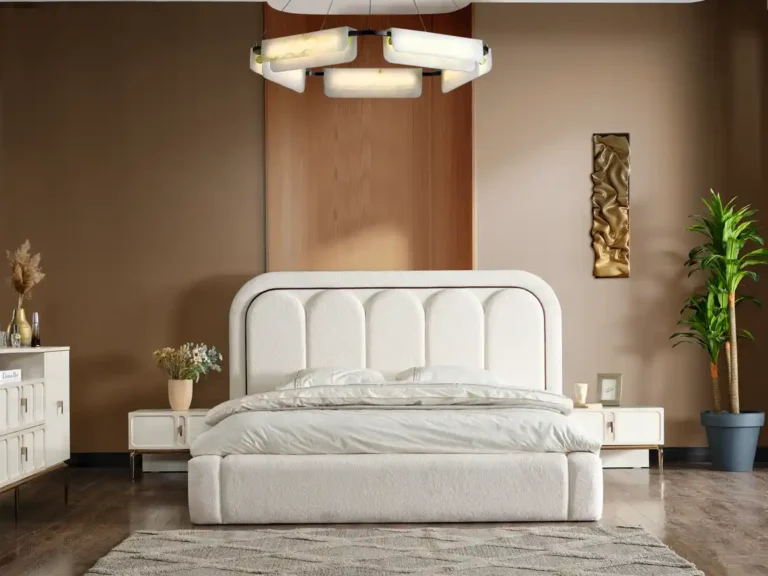
M&I Interiors can help customers plan a bedroom around comfort, available space, storage and personal style. The range includes the luxury bed collection, coordinated bedroom furniture, luxury bedroom wardrobes and made-to-measure bedroom curtains that can help control light and complete the room.
Choosing the right proportions is particularly important where a room must accommodate a larger bed, wardrobes, bedside tables or additional storage. M&I’s Irish bed-size guide explains common dimensions, while the company’s home-size statistics for Ireland provide wider context on the changing scale of Irish homes. These resources can help customers make informed furnishing decisions, but anyone experiencing persistent sleep problems should consult the HSE guidance or an appropriate healthcare professional.
For more context on Irish homes and furnishing choices, see M&I Interiors’ statistics roundups covering apartment living in Ireland, new homes in Ireland and Irish furniture market trends.
Methodology and limitations
This article was compiled by M&I Interiors from the Department of Health’s Healthy Ireland summary report, the Department’s open sleep-duration data table and sleep-quality data table disseminated through the CSO PxStat service, and Eurofound’s EU sleep comparison. The sources were reviewed on 11 September 2026. M&I Interiors is the compiler of this roundup, not the original research authority.
The 2025 survey methodology used a nationally representative sample of 7,556 people aged 15 and over living in the Republic of Ireland, with interviews conducted by telephone between October 2024 and April 2025. The sleep figures are survey estimates based on respondents’ answers. They are not administrative totals, clinical diagnoses or measurements from sleep-monitoring devices.
The year 2026 in the title is the publication year of this roundup, not the period measured by every statistic. The newest central figures describe the 2025 survey, while 2019 and 2024 figures are retained for comparison. The 2019 survey used face-to-face interviews, whereas the 2024 and 2025 surveys used telephone interviews. Percentages are rounded as published, so category totals may not always equal exactly 100%.
This page covers the Republic of Ireland and should not be interpreted as an all-island estimate. It also keeps duration and quality separate because they use different questions and reference periods. Comparisons between groups are descriptive and do not establish causation.